
We explore the fundamental limits of how information travels through light.
Our work treats the optical channel not just as a pipe for data, but as a complex physical system that can be modelled, adapted to, and even used for computation. We bridge the gap between abstract information theory and real-world implementation through three core pillars:
- Experimental Systems: We build what we model. This includes designing next-generation long-range free-space optical (FSO) links and high-speed visible light communication (VLC) systems.
- Theoretical Foundations: We develop novel coding and signal processing frameworks specifically tailored to the unique physics of optical turbulence and non-linear channels.
- Machine Intelligence: We integrate AI not just as a tool for prediction, but as a new paradigm for controlling light propagation and solving inverse problems.
Facilities: The Playground
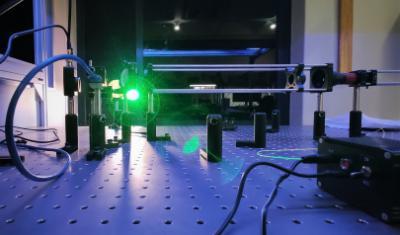
Simulation is only the first step. Our dedicated free-space optics laboratory is equipped with the hardware necessary to test theory against reality:
- Programmable Optics: Spatial Light Modulators (SLMs) for complex wavefront shaping.
- Software Defined Radio: Universal Software Radio Peripherals (USRPs) and FPGAs for high-speed signal processing.
- The Urban Link: A permanent, 300-metre free-space optical link across the university campus, providing a real-world testbed for turbulence mitigation and kilometre-scale experiments.
Current Research Frontiers
Our projects are not isolated silos; they are focused applications of our core themes. Here is what we are working on right now:
All-Optical AI: Computing with Light
Atmospheric turbulence is usually seen as a nuisance that scrambles signals. We are flipping the script: we treat the turbulent medium as a physical "Hidden Layer" in a neural network. By exploiting the natural matrix-vector multiplications that occur as light scatters through the air, we are investigating how to perform "accidental" computation at the speed of light. This turns a communication channel’s biggest liability into a computational resource.
Long-Range Free-Space Optics
What are the ultimate limits of data rate and distance for laser communications? We are pushing these boundaries using Structured Light—complex optical modes (like Orbital Angular Momentum) that increase channel capacity. We design bespoke error-correction codes and use machine learning to predict the channel’s chaotic behaviour milliseconds before it changes, allowing our systems to adapt in real-time.
Frugal Engineering: Bridging the Digital Divide
High-tech doesn't have to mean high-cost. We are developing accessible, 3D-printed optical wireless systems using off-the-shelf components. The goal is to democratise high-speed connectivity for underserved communities while providing an agile hardware platform for field-testing our new coding schemes.
Hybrid Communication Systems
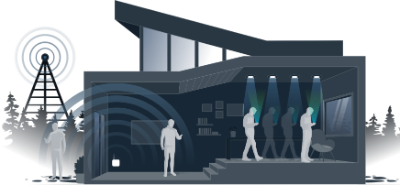
Reliability is key. We are designing hybrid systems that seamlessly switch between optical wireless, radio frequency (RF), and powerline communications (PLC). By developing novel coding techniques that span these physical layers, we ensure robust connectivity even when the optical channel is blocked.
Publications
Please feel free to visit our individual ResearchGate or Google Scholar pages (accessible via the "Team" page) for up to date research publications.
For your convenience we also have an embedded view of selected publications below: